

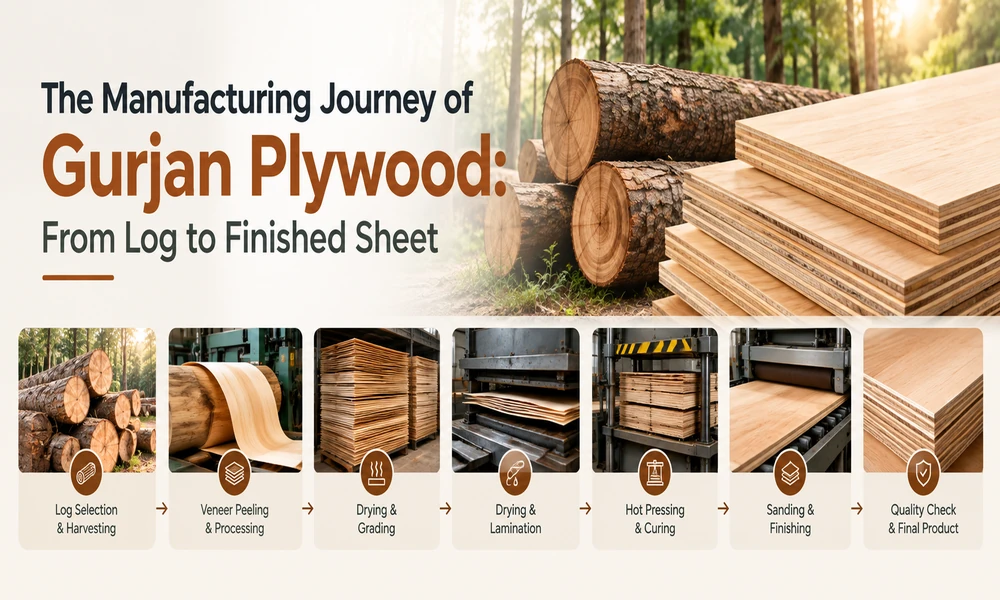
A plywood sheet may appear merely to be stacked in a dealer’s warehouse; its performance has started long before. The quality of Gurjan plywood relies on numerous steps before timber becomes a finished board, such as timber selection, the application of technology to make veneers, layers of plywood construction, bonding and finishing, thus influencing strengths like stability, durability, hold of screws.
For customers and manufacturers, this process shows the importance of plywood construction besides its design.
1. Choosing and Preparing Gurjan Timber
The process begins with the proper selection of Gurjan timber. Gurjan refers to the wood protruding from tree species belonging to the Dipterocarpus family, which is distinguished by its density and durability. In this way, this type of timber was selected for plywood production.
When logs are picked up, they are made ready for conversion to veneers, meaning that the final goal is to produce additional ready-to-use wooden veneers to lay them into a plywood panel.
The quality of timber used is relevant at this stage, as characteristics of wood define the final properties of veneers.
2. Producing Veneers of Timber
Plywood is made of multilayer veneer sheets, which are produced from logs. Here, special technology is used to get wooden sheets.
The terms Gurjan face and Gurjan core can refer to Gurjan plywood, making Gurjan face plywood and Gurjan core plywood distinct products.
Gurjan face plywood refers to plywood made from Gurjan wood for the outer veneer, whereas the core can be made from other types of wood.
Gurjan core plywood refers to plywood which uses Gurjan wood in the core construction of the plywood, as per the specifications provided by the manufacturer.
This difference is important to ensure that the plywood is made entirely from Gurjan while purchasing it.
3. Preparing the Plywood Panel
Once the veneer has been prepared, the layers of the panel are assembled.
The veneers are arranged in layers one over the other, with the grain direction placed in a way that maximises the stability of the panel.
The layers are bound by applying glue.
The way in which the plywood is bonded is important in determining the quality of the finished product.
A properly manufactured plywood panel should be made up of even layers with no gaps in between.
By inspecting the edges of the panel, one can gauge its construction quite well.
Therefore, it is necessary to check the edge as well as the cross-section of the panel to ensure that the plywood has been constructed properly.
The way in which the plywood is manufactured has an impact on the important characteristics of the panel, such as its dimensional stability and screw retention, which will be useful for making furniture, wardrobes, cabinets and
4. Pressing, Finishing and Quality Checks
After the veneers have been manufactured and bonded, the pressed plate is subjected to pressing in order to combine the layers to form a single board. The ensuing panel undergoes further processing to achieve the desired dimensions and surface quality.
Quality control does not stop after pressing is complete. The finished sheet of plywood can undergo a series of physical inspections and checks.
Important checkpoints are:
Uniform thickness: Uniform thickness helps in obtaining the correct measurements required for furniture work.
Layer construction: The edges must reflect well-formed and uniform layers.
Surface appearance: Gurjan is generally reddish-brown to brown in colour and has a fine matrix, although the colour cannot certify the wood.
Weight and density: Gurjan is a hard wood, although various other factors influence the overall weight of the sheet.
Sound: Tapping could give information about possible imperfections in the board, but the tap sound cannot indicate whether the board is made of Gurjan wood.
Documentation: The relevant certification must be checked apart from the data about the wood species.
5. From Finished Sheet to Furniture
When the required manufacturing and quality checks for the plywood are met, the plywood starts its journey towards becoming the main raw material for the furniture industry. Gurjan plywood is usually used for making wardrobes, cabinets, beds, desks, partitions, etc.
The board can undergo further cutting operations and can be machined to suit the design requirements. Its performance depends on the required specifications as well as how the finished product is constructed, installed and maintained.
For customers who are planning to buy Royale Touche Plywood, it is vital to ensure that the specifications of the product match the requirements exactly. It is crucial in case there is a difference between Gurjan face and Gurjan core.
Conclusion
So the first stage of Gurjan plywood is lumber selection, and it is followed by veneer production, layer construction, glueing, pressing, finishing, and quality control processes. All these stages influence the properties of the finished sheet.
One important thing for customers is that the term “Gurjan” is not enough to define what the plywood is made of. You need to check the specifications of the face and core of the product, layer construction, and other documentation.
