

A cloud of small dark flies gathers over the kitchen sink each evening. A scatter of tiny flies appears on the bathroom mirror when the shower runs. A group of small flies rises in a puff every time the peace lily gets watered. These three scenes describe three different species with three different breeding sources and three different treatments, and nearly every homeowner who encounters one of them assumes it is fruit flies. Kansas City pest control companies fielding small-fly calls, including ZipZap Termite & Pest Control in Lawson, see the same misidentification pattern constantly. The vinegar trap that reliably handles one species does nothing against the other two, and the weeks a homeowner spends cycling through consumer remedies usually end with the original infestation still intact. Getting the identification right in the first five minutes saves the rest of the work.
The Three Species and Why They Look Different on Close Inspection
All three fly groups are small, fast, and dark, which is why homeowners confuse them. The differences show up within a few seconds of actually looking carefully.
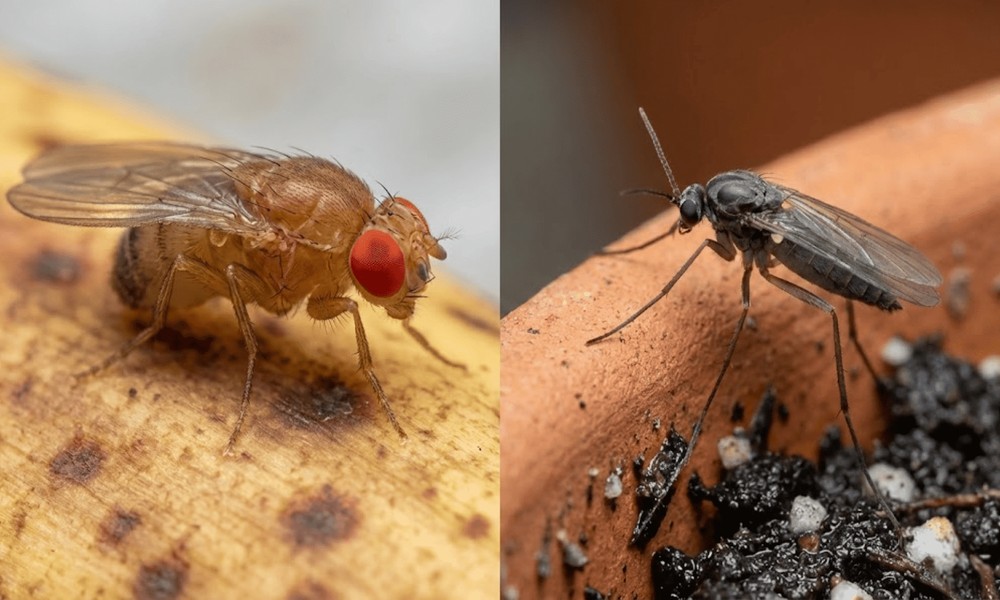
Fruit flies (Drosophila melanogaster is the most common species) are tan to brownish with red eyes. Body length is roughly 1/8 inch, the body is oval and stout, and they fly in slow, hovering patterns near food sources. The red eyes are the most reliable immediate diagnostic: catch one on a windowsill or on a piece of tape, and the color is often visible to the naked eye.
Drain flies (family Psychodidae, also called moth flies) are the most visually distinctive of the three. They are roughly the same 1/8 inch size, but their bodies and wings are covered in fine gray or tan hairs, giving them a fuzzy, moth-like appearance. The wings are held tent-like over the body at rest, which makes them look triangular rather than sleek. Flight is weak and erratic. Most drain flies do not travel far from the drain they emerged from, and finding them predominantly near sinks, showers, or floor drains is itself diagnostic.
Fungus gnats (family Sciaridae) are the slenderest of the three, with long legs, long thin wings, and a more mosquito-like profile. They are slightly smaller than the other two on average and fly weakly in short hops rather than sustained flight. Populations cluster near houseplant soil and are often first noticed when watering disturbs them into flight.
A magnifying glass or a phone camera with a macro setting can confirm any of these identifications in under a minute. A homeowner who cannot be bothered to look closely will often spend weeks treating the wrong species.
Why Treatment Differs Completely for Each
The key insight is that each species breeds in a specific substrate, and treatment is substrate-removal rather than adult-fly killing. The vinegar traps sold for fruit flies, for example, work because fruit flies are attracted to fermenting odor. They do not work on drain flies or fungus gnats because those species are not attracted to fermenting food.
Fruit flies breed in fermenting produce, drink residue in bottles and cans in recycling bins, spills inside liquor cabinets, overripe bananas in a fruit bowl, mop buckets, and the bottom of garbage disposals. The adult population in the kitchen indicates a food source somewhere nearby, and elimination requires finding and removing that source. Common hidden sources include a forgotten onion in a pantry basket, a potato that rolled behind a lower cabinet, and the residue in unrinsed recycling.
Drain flies breed in the biofilm that builds up inside drain lines, P-traps, floor drains, and the overflow holes in bathroom sinks. The gelatinous film is a mix of organic debris, soap residue, and bacterial slime, and drain fly larvae feed on it while living submerged inside it. Treatment requires mechanical cleaning of the drain interior (a drain brush run through the line, followed by enzymatic drain cleaner designed for biofilm digestion) rather than pouring bleach or surface insecticide down the drain. Bleach and chemical drain cleaners rarely reach the full drain length where biofilm accumulates, and even when they do, the biofilm often rebuilds within weeks.
Fungus gnats breed in consistently moist potting soil. Overwatered houseplants, plants in pots without adequate drainage, plants sitting in water-retaining saucers, and soils high in decomposing organic matter all support fungus gnat populations. Treatment is soil-based: allow the top two inches of soil to dry completely between watering (fungus gnat larvae cannot develop in dry soil), repot seriously infested plants in fresh sterile potting mix, or apply a Bacillus thuringiensis israelensis (Bti) drench to the soil. Bti larvicide kills larvae without harming plants, pets, or beneficial soil organisms.
Why the Same Trap Does Not Handle All Three
A homeowner who treats a kitchen fly problem with a vinegar-and-dish-soap trap and sees initial success often assumes the approach works against all small flies. It does not.
Vinegar traps exploit the fermentation attraction of fruit flies. Drain flies are not attracted to fermentation odors; they emerge from drains, rest on adjacent walls, and do not significantly respond to apple cider vinegar bait. Fungus gnats are attracted to yellow sticky traps (commercial versions sold as Gnat Stix or similar) but respond poorly to fruit fly bait.
Yellow sticky traps set next to houseplants catch fungus gnats reliably and confirm identification, but the trapping is monitoring rather than elimination. The breeding substrate still needs to be addressed for the infestation to resolve.
Insecticide sprays of any kind rarely help with any of the three species because the larval population lives protected inside the food, biofilm, or soil where the spray does not reach.
When Kansas City Pest Control Involvement Makes Sense
Most small-fly problems resolve with correct identification and substrate-specific treatment. Several situations warrant professional assessment.
Drain fly populations that persist after enzymatic cleaning of every visible drain usually indicate a hidden source: a cracked or leaking drain line inside a wall, a condensation line from an HVAC system that has developed biofilm, a sump pit with biofilm on the interior walls, or a floor drain that has not been located because it was covered during a remodel. A Kansas City pest control provider with experience in structural fly-source tracing can identify these sources through plumbing inspection, thermal imaging, or diagnostic dyes run through the system.
Fruit fly populations in commercial kitchens and food-service spaces often involve sources inside equipment (the drip trays of refrigeration units, the undersides of fryers, the seal gaskets of walk-in coolers) that require professional evaluation.
Multi-unit apartment buildings with drain fly issues usually need building-wide assessment because the drain system connects across units.
The Short Version
Fruit flies, drain flies, and fungus gnats are three separate species with three separate breeding substrates and three separate treatments. Visual identification takes less than a minute with a phone camera or a magnifier. Fruit flies need the food source removed. Drain flies need the drain biofilm physically cleaned. Fungus gnats need the soil to dry out or be replaced. For persistent small-fly problems that resist substrate-specific treatment, a Kansas City pest control provider such as ZipZap Termite & Pest Control can locate hidden sources that home inspection cannot, and fix the problem rather than just treat the symptom.
